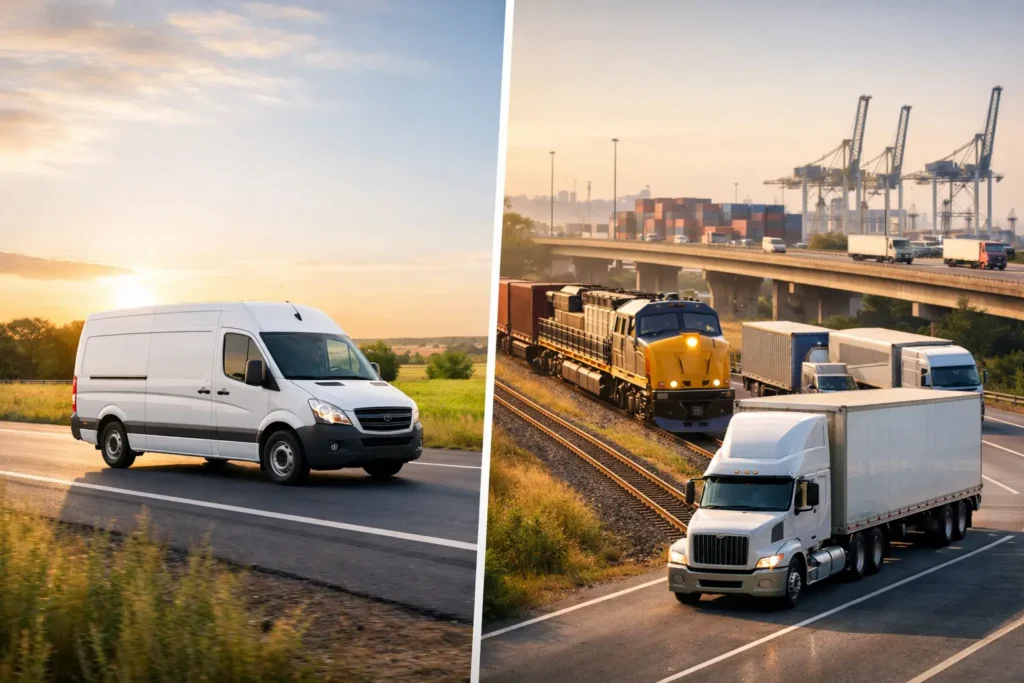
A missed production component, a legal bundle needed before close of business, or a high-value display unit arriving damaged can cost far more than the transport charge. That is why the choice between a dedicated vehicle versus freight network service deserves more than a quick price comparison. Each model solves a different operational problem, and selecting the wrong one can introduce avoidable delay, handling risk and uncertainty.
For urgent and business-critical consignments, the right answer is often determined by the delivery promise you have made to your customer, not simply the distance or the size of the load.
What a dedicated vehicle service delivers
A dedicated vehicle is assigned specifically to your consignment. Once collected, it travels directly to the agreed delivery point, with no depot sorting, route-sharing or planned transhipment along the way. The vehicle and driver are focused on your job from collection through to proof of delivery.
This approach is particularly valuable when time is tight. A same day collection in London, for example, can be taken directly to a destination elsewhere in the UK without waiting for a scheduled network departure. You have a clear collection window, a named vehicle solution and a delivery plan built around the requirements of that individual job.
Dedicated transport also reduces physical handling. Goods are loaded once and unloaded once in most cases, which is a significant advantage for fragile equipment, confidential documents, medical supplies, exhibition materials, retail fixtures and high-value stock. Fewer handovers mean fewer opportunities for damage, misrouting or delays caused by a busy hub.
Visibility is another practical benefit. With real-time tracking and direct communication, operations teams can monitor progress and update their own customers with confidence. If access instructions change, a site contact needs to be called, or a delivery time has to be coordinated precisely, the service can respond without disrupting a wider network schedule.
The trade-off is cost. Because the vehicle capacity is reserved for one customer, you pay for the resource rather than sharing transport space with other consignments. For a non-urgent carton or standard pallet, that premium may not be necessary. For a job where lateness creates downtime, lost revenue or reputational damage, it can be the most commercially sensible option.
How a freight network works
A freight network combines consignments from multiple customers to move them through a planned distribution system. Goods are collected, taken to a depot or hub, sorted, linehauled to another depot where required, then sent out for final delivery. Overnight pallet distribution commonly operates this way.
The main advantage is efficiency. By consolidating freight, networks spread transport costs across many consignments. This can make them a strong option for planned pallet movements, regular replenishment, non-urgent stock transfers and deliveries where a next-day or economy service meets the receiving site’s requirements.
A well-managed network gives businesses broad geographic reach without needing to arrange an individual vehicle for every shipment. It is often the right fit when volume is consistent, lead times are predictable and the goods are packaged to withstand normal freight handling.
However, a network has fixed operational stages. A consignment may pass through several facilities and be handled by more than one team before it reaches its destination. That does not make a freight network unreliable, but it does mean the delivery is dependent on cut-off times, depot processing, linehaul schedules and final-mile capacity. A late collection can miss the planned service, while congestion at a hub can affect many shipments at once.
For goods that are unusually delicate, time-sensitive or difficult to replace, those additional touchpoints need careful consideration. A network delivery can be cost-effective, but it is not designed to offer the same level of direct control as a dedicated vehicle.
Dedicated vehicle versus freight network: the key differences
The simplest distinction is this: a dedicated vehicle prioritises control, speed and reduced handling; a freight network prioritises consolidation, coverage and lower unit cost.
Delivery speed is usually the first deciding factor. A dedicated courier can collect and travel immediately, making it suitable for same day, timed and out-of-hours work. A network follows established service timetables. Even where next-day delivery is available, it is generally subject to collection cut-offs and service-area schedules.
Handling is equally important. Direct transport normally keeps your goods on one vehicle for the journey. Network freight is transferred through hubs as part of the distribution process. Standard, well-packaged pallets are often well suited to this model. A white glove item, sensitive electronic equipment or an irreplaceable prototype may need the more controlled journey offered by a dedicated service.
Cost should be assessed in context. Network freight generally offers a lower price for planned, shareable capacity. A dedicated vehicle costs more upfront, but its value can be substantial when it prevents a production line stoppage, keeps a project on programme or protects a premium customer experience.
Finally, consider flexibility. Dedicated transport can accommodate specific collection times, direct routing, multiple delivery points where practical, driver instructions and specialist requirements such as two-man delivery. A freight network is more structured. It performs best when the consignment, packaging and timing fit the service rules.
Questions to ask before choosing a service
Start with the true deadline. Does the item need to arrive today, at a defined time, or simply by the next working day? If the recipient needs it for a meeting, installation, production run or onward transport, a vague delivery window may create unnecessary risk.
Then assess what is being moved. Consider the value, dimensions, fragility and replacement lead time. A pallet of durable packaged goods may travel very effectively through an overnight network. A bespoke part that cannot be replaced for weeks needs a different level of protection and accountability.
It also helps to consider the receiving location. A distribution centre with booked-in pallet slots may be well suited to network freight. A construction site, hospital, exhibition venue, office floor or residential address may require more precise coordination. In these cases, direct driver communication, timed arrival and tailored handling can be more useful than a standard network service.
Ask what happens if the delivery is delayed. If the answer is minor inconvenience, a network service may offer the best balance of cost and performance. If delay stops work, causes a contractual issue or harms a customer relationship, a dedicated vehicle offers greater certainty.
When a blended approach makes sense
Most established businesses do not need to choose one model for every consignment. The strongest transport strategy often uses both services for the jobs they suit best.
A retailer might send routine replenishment pallets through an overnight freight network, while using a dedicated vehicle for urgent store stock-outs. A manufacturer may book scheduled network distribution for finished goods but arrange direct same day transport when a critical component is needed to keep machinery running. A facilities team could use standard freight for planned moves and a two-man or white glove service for equipment that requires careful placement on site.
This blended approach keeps routine transport spend under control without forcing urgent or specialist work into a service model that was not designed for it. It also gives procurement and operations teams clearer internal rules: network freight for planned, properly packaged consignments; dedicated transport for urgent, high-risk or high-touch deliveries.
Getting the service level right
The best booking decisions are made before goods are ready to move. Share accurate weights, dimensions, collection and delivery access details, available time windows and any handling requirements at the point of enquiry. This allows the transport provider to recommend the appropriate vehicle, service level and route rather than fitting a complex job into an unsuitable standard option.
For recurring work, an account-based arrangement can bring further consistency. Regular lanes, delivery expectations and reporting requirements can be agreed in advance, while urgent exceptions still receive a rapid response. Destiny Couriers supports this kind of tailored planning, combining direct vehicle services for time-critical work with practical freight options for scheduled distribution.
When the next delivery carries a tight deadline or a high customer expectation, choose the service based on the consequence of getting it wrong. That decision protects more than a consignment – it protects your operations, your customer promise and the confidence people place in your business.